
It is estimated that global e-commerce sales will go beyond $6.88 trillion in 2026.
That’s a huge number, isn’t it? But how much of that growth is your business getting?
E-commerce is evolving rapidly: consumer demands are increasing, new technologies are emerging, and competitors are popping up everywhere. Besides price, you are now competing on the basis of experience, speed, personalization, and convenience.
That’s why keeping up with the latest eCommerce trends is important. These trends impact how much revenue you can generate, how fast you can grow, and how well you can serve your customers.
In this blog, we will walk through the top eCommerce trends that can transform your revenue in 2026. Let’s see how these trends can boost your revenue.
How eCommerce Trends Transform Revenue
eCommerce trends affect how much you sell and how often customers come back.
Aligning with the right trends makes you update with customer expectations. Meeting these expectations increases the probability of purchases being completed rather than abandoned halfway.
If they know where to get their needs and can smoothly go through the checkout, then your conversion rate will rise.
Another important impact is repeat purchases. Features like personalized suggestions, easy reordering, and faster service encourage customers to return. This builds consistent revenue instead of one-time sales.
In simple terms, eCommerce trends let you expand your business efficiently.
Top 10 eCommerce Trends in 2026
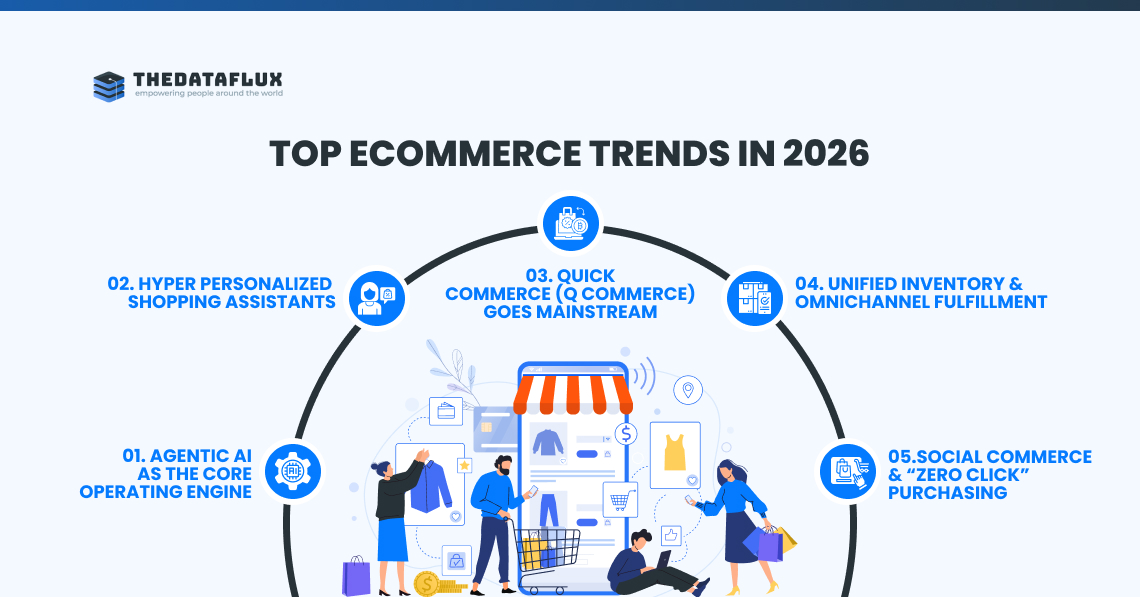
1. Agentic AI as the Core Operating Engine
AI is turning into the brain of your eCommerce business. From managing inventory to handling customer queries and pricing, AI can make decisions in real time. By reducing manual tasks and improving your speed in adapting to market fluctuations, you are also improving efficiency and revenue.
2. Hyper-Personalized Shopping Assistants
Today, clients expect stores not just to sell but to get their preferences. AI-powered shopping assistants can recommend items by keeping an eye on users’ behavior, like what they like to browse, what they bought before, and what they are interested in this way, making the shopping experience personal and increasing the chances of successful sales.
3. Quick Commerce (Q-Commerce) Goes Mainstream
Fast delivery is becoming a standard expectation. Customers now prefer getting products within hours instead of days. Businesses that make it possible for their customers to shop through quick commerce options stand to benefit from attracting new customers, as well as from customers who are placing more orders, notably when it comes to products used daily.
4. Unified Inventory & Omnichannel Fulfillment
Customers shop across websites, apps, and physical stores. A unified system helps you manage inventory across all channels in real time. This will make sure that you never run out of stock, and at the same time, you will be able to fulfill orders, resulting in higher customer satisfaction and a lower chance of losing sales.
5. Social Commerce & “Zero-Click” Purchasing
Consumers are no longer going to a store’s site to make the purchase, but are buying straight from social media platforms. In-app checkout, instant purchase options, and similar features not only reduce steps during the purchasing process but also make the process so simple that shoppers are more likely to make impulse purchases.
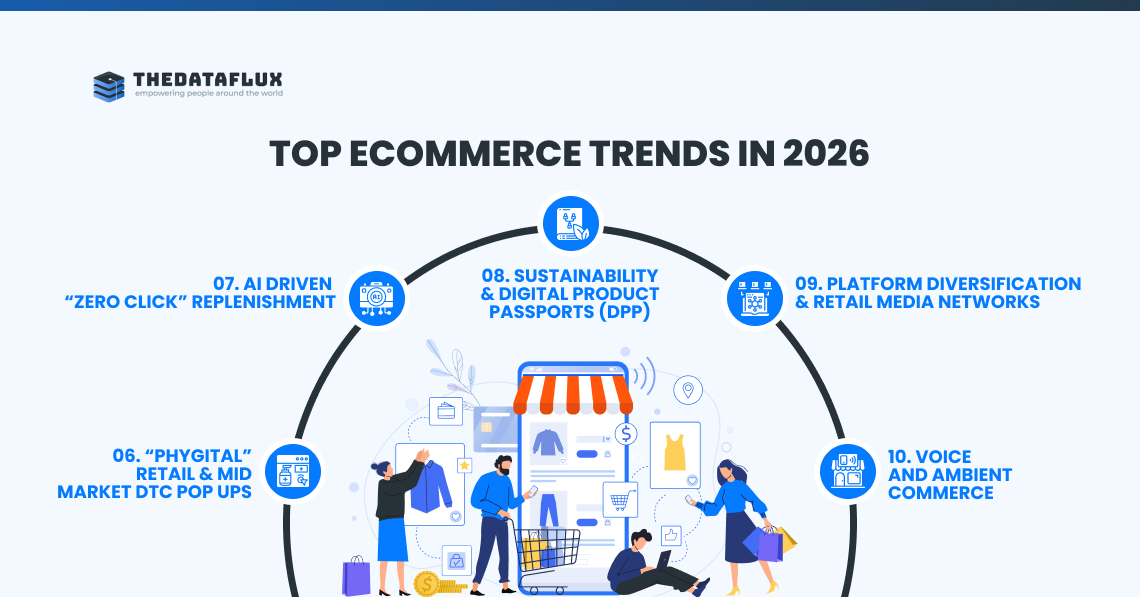
6. “Phygital” Retail & Mid-Market DTC Pop-Ups
The line between online and offline shopping is fading. Brands come up with physical events such as pop-up stores, and at the same time keep their online presence robust. This builds trust, improves customer experience, and helps customers connect better with the brand.
7. AI-Driven “Zero-Click” Replenishment
Reordering is becoming automatic. AI monitors the patterns of customers’ product usage and will place orders for the replenishment of items even before customers realize that they are totally out of stock. This feature will be especially effective for everyday-use products and subscription services, as it helps companies to generate stable and recurring income
8. Sustainability & Digital Product Passports (DPP)
People these days are getting more aware of the impact of their purchases. They want to know where products come from and how they are made. Digital product passports provide complete transparency, thereby implementing trust and impacting consumer behavior.
9. Platform Diversification & Retail Media Networks
Now, most companies are going multi-channel shopping around some combination of marketplaces, e-commerce sites, and mobile apps. Additionally, retail media networks provide brands with the opportunity to run advertisements within these platforms, thus leading to the creation of new revenue streams.
10. Voice and Ambient Commerce
The introduction of voice assistants, together with other smart devices, completely alters the way people buy. It is possible to carry out product search and reordering, as well as buying, simply by issuing voice commands. As the adoption increases, companies need to align their platforms with voice-activated interactions.
Benefits of eCommerce Development
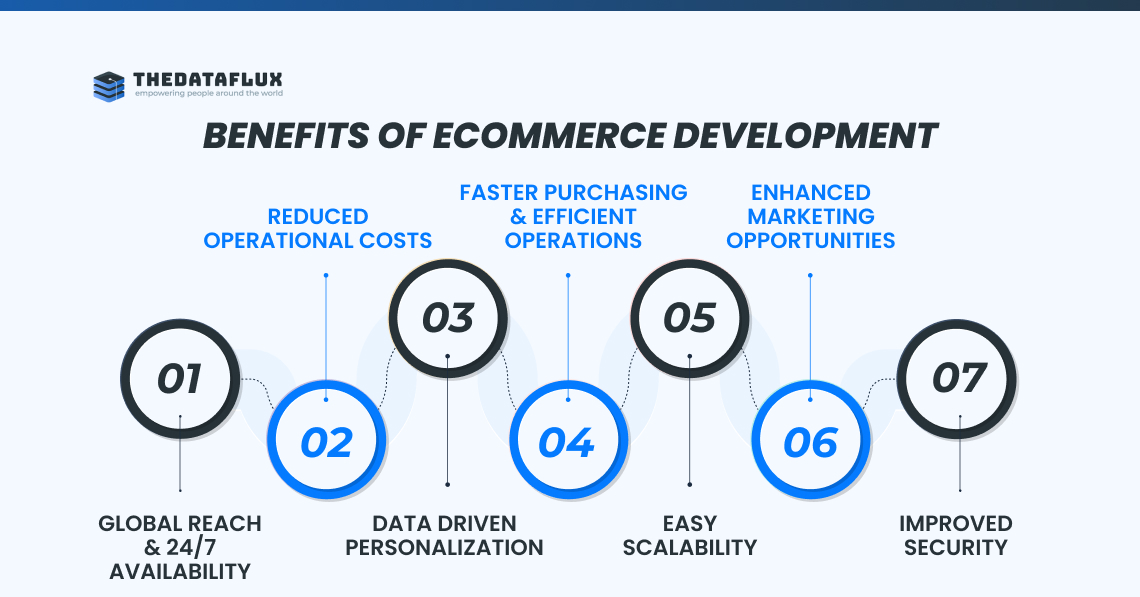
1. Global Reach & 24/7 Availability
E-commerce breaks down the boundaries of geographical location and time. Your shop is always available online, which means customers from any part of the world can come and buy at their convenience.
2. Reduced Operational Costs
Operating an online store generally requires smaller expenditure as compared to running a physical store. Besides the store’s rent, you can also save on staffing and other overhead costs.
3. Data-Driven Personalization
Storing online allows you to record your customers’ data, such as their behavior and preferences. In that way, you are able to provide customized experiences that not only increase sales but also encourage customer engagement.
4. Faster Purchasing & Efficient Operations
Online systems simplify the customer journey by turning it into an effortless one. Meanwhile, you can also use automation to effectively manage orders, stock, and payments.
5. Easy Scalability
As your business grows, you can easily expand your online store. You can add more products, handle more orders, and enter new markets without major changes.
6. Enhanced Marketing Opportunities
There are many online marketing tools that will enable you to speak to your target audience directly by switching on ads, sending marketing emails, or using social networks. You will be able to attract new customers and convert a higher percentage of those who visit your store.
7. Improved Security
The leading e-commerce platforms today provide safe payment gateways as well as tools to protect customer data. As a result, customers feel secure and are more willing to complete transactions.
Conclusion
eCommerce is changing fast. Customers now demand not only quicker delivery but also better overall shopping experiences and more personalized communication. If you are not making changes according to these new demands, you are essentially losing potential areas for generating real income.
The trends we discussed are not just future ideas. Many of them are already being used by businesses that are growing faster and staying ahead of the competition.
At The Dataflux, we use data and research to figure out how consumer behavior is changing and then guide our clients to design their eCommerce platform in a way that is practical, scalable, and future-proof.
See you in the next blog, or maybe while we’re helping you turn the right eCommerce trends into real business growth.
FAQs
Q- What are the e-commerce trends in 2026?
A- Some key eCommerce trends in 2026 include AI-driven automation, hyper-personalization, quick commerce, social commerce, and voice-based shopping. These trends focus on improving customer experience and making buying faster and easier.
Q- Is ecommerce still profitable in 2026?
A- Yes, eCommerce is still very profitable in 2026. With the right strategy, tools, and customer experience, businesses can reach more customers and generate consistent revenue online.
Q- What are the 7 C’s of e-commerce?
A- The 7 C’s of eCommerce are Content, Commerce, Community, Communication, Connection, Customization, and Context. These elements help businesses create a better online experience and improve customer engagement.
Q- What are the 7 major types of e-commerce?
A- The main types of eCommerce are 1. B2C (business to customer), 2. B2B (business to business), 3. C2C (customer to customer), 4. C2B (customer to business), 5. D2C (direct to customer), 6. B2G (business to government), and 7. G2C (government to customer). Each type defines how transactions happen between different groups.