
Did you know that developers spend about 75% of their time that they spend only finding and debugging? That’s right—three-quarters of their time goes into finding and fixing bugs instead of building new features or improving the product. However, many bugs still get into production because users experience crashes, delays, and frustration.
Let us face it that traditional software testing is falling far behind. Today, development cycles move at speed. Manual testing takes time. It’s expensive. It’s often inconsistent. Even with a sharp QA team, you cannot catch every bug given limited time plus resources.
More testers and more development teams are turning to AI-powered bug detection for this exact reason. It’s fast. It’s smart. And bugs are found and then fixed in a transforming way.
In this blog, we will walk you through the real challenges of traditional QA, and we will explain how AI is solving them and is becoming a trusted sidekick for every tester.
Common Problems with Traditional QA
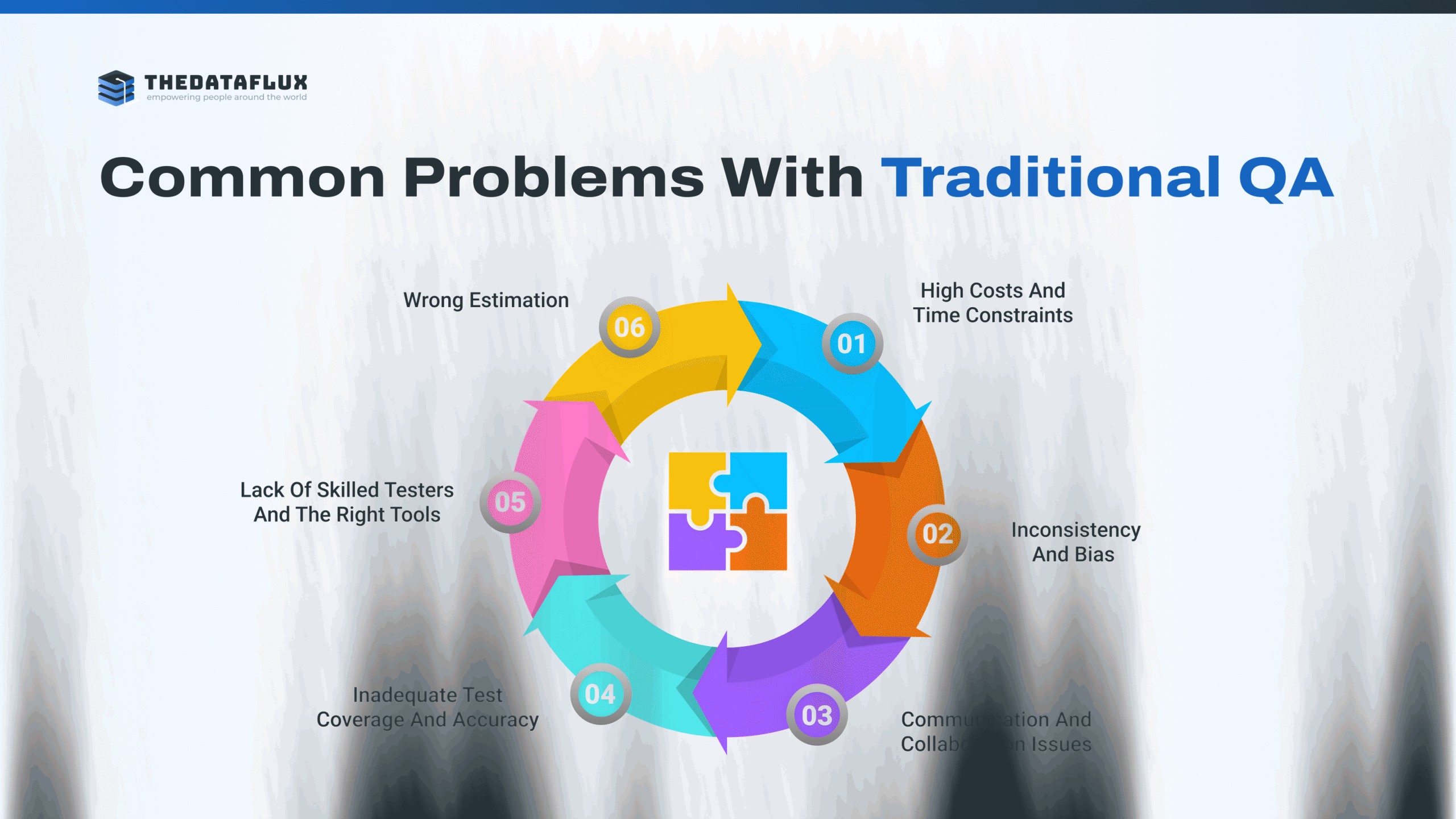
Let’s be honest- traditional QA is not broken, but it certainly struggles to keep up. Today, the software world is more complex, faster, also under more pressure than ever. The testing methods that worked before now feel outdated. Here are some of the most common challenges teams face:
1. High Costs and Time Constraints
Manual testing consumes lots of time. Indeed, we all know that time equals money. QA teams are stretched so thin with the constant release cycles, the short sprints, and the tight deadlines. Testing consumes time. If testing increases, innovation suffers.
2. Inconsistency and Bias
Humans are great, but we’re not perfect. Repetitive tasks in particular cause testers to unintentionally miss bugs. Bias also can influence how thoroughly someone tests something; what one person prioritizes, another might not even notice.
3. Communication and Collaboration Issues
Testing occurs outside a vacuum. Coordination that is close is a need between developers and testers, and at times even product teams. But in many cases, when people communicate with paucity, that delays, misunderstands, or misses bugs.
4. Inadequate Test Coverage and Accuracy
Testing every single path, input, or user behavior manually beyond large applications is impossible. Some areas receive less attention as a consequence. This raises the odds of overlooking bugs until it is too late.
5. Lack of Skilled Testers and the Right Tools
Finding testers familiar with the domain and tools is hard. Even the right people can have their efficiency limited via clunky or outdated tools. If testing lacks proper automation or support, then it becomes slow, and testers make errors.
6. Wrong Estimation
Projects hurt more than most people realize from this one. Plans for release can derail with ease. The cause is often underestimating QA time or effort. Overestimating can waste resources. Either way, traditional approaches make that risk difficult to manage.
How AI is Transforming Automated Bug Detection
We are not just talking about smarter software; we are talking about a change such that bugs get detected and tracked, and get fixed. QA uses AI now. It is not futuristic anymore. It is occurring now, also it fixes issues that regular testing did not.
The Role of AI in Bug Detection
AI steps in where human testers fight with manual scripts. It is able to check many codes. It is able to analyze logs as well as test cases very rapidly. It is not weary, unfocused, or prejudiced. It learns all the time, growing when it finds each bug. Testers find errors before they make problems using AI with pattern ID oddity sensing and future guessing.
How AI is Improving Bug Detection
AI can auto-generate tests from code changes, avoiding manual test case writing for every feature. This saves time for developers and makes sure testing is more thorough. Behavior patterns spotlight strange actions that might show there is a bug.
Some AI tools can even give priority to bugs based on severity, and that helps teams focus on the things that matter most. And since it works all hours, AI lets teams find errors sooner in the growth cycle before they turn into big issues.
The real beauty? AI does not replace testers; rather, testers are given more power. Tasks that are repetitive and take time get overtaken so testers can focus on quality strategy, exploratory testing, and critical thinking.
Benefits of Using AI Bug Detection
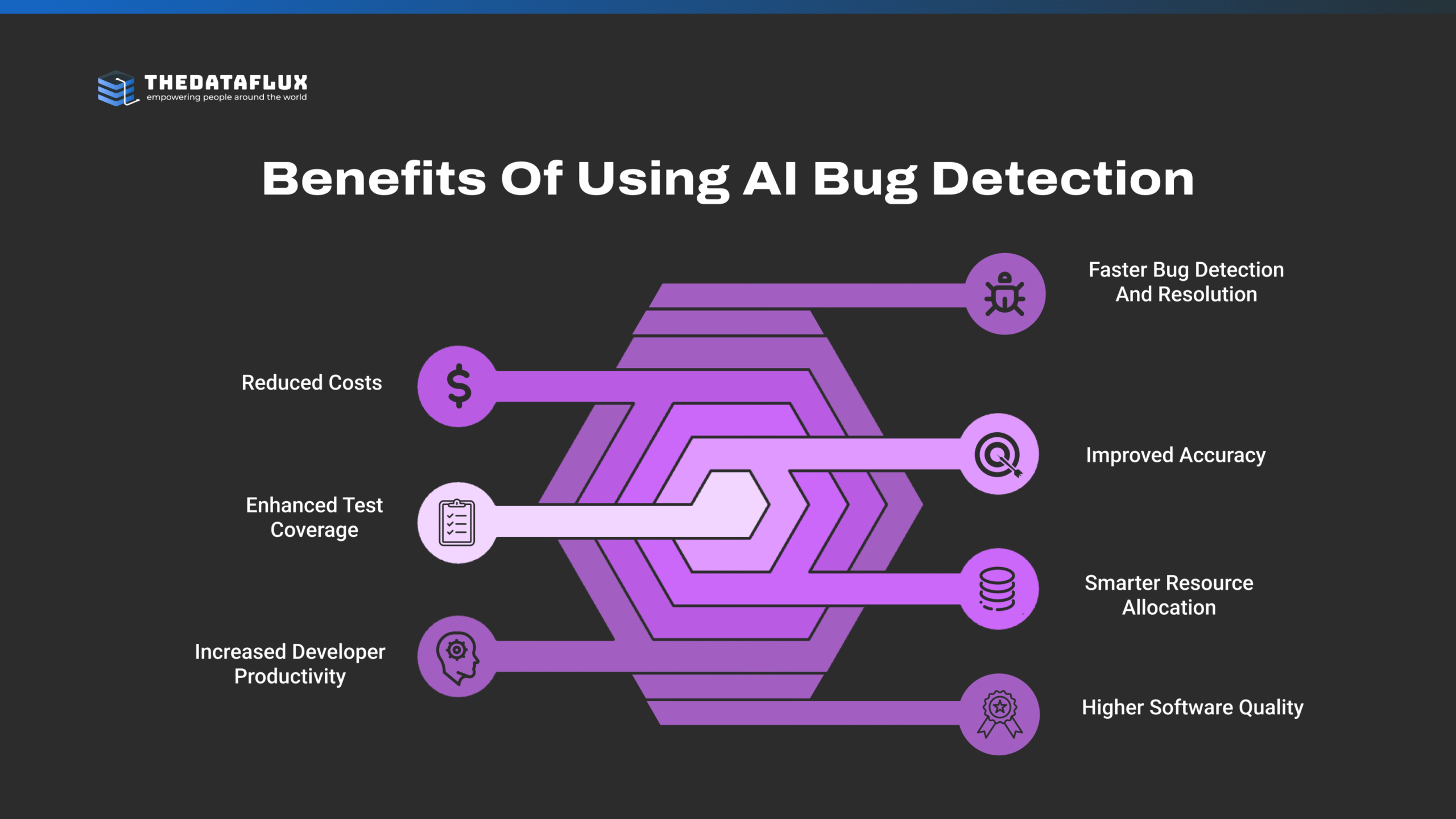
• Faster Bug Detection and Resolution
AI quickly scans large codebases, soon finding bugs that humans may take hours to detect. Since this quickens test times, it lets teams repair problems sooner, and it stops slowdowns afterward during development.
• Reduced Costs
AI lessens the demand for much hand testing by making routine tasks automatic. It also does catch some bugs sooner. This cuts down on both rework and staffing costs, and also makes for a QA process that is more cost-efficient.
• Improved Accuracy
AI consistently analyzes data with code patterns, eliminating human errors. It finds secret or hard bugs with better exactness, and it cuts the chance of skipped problems.
• Enhanced Test Coverage
AI makes many kinds of test cases in different situations. AI runs the tests, and corner cases are also there. More complete coverage than normal testing methods is made sure of.
• Smarter Resource Allocation
AI handles routine QA duties so that coders and testers can center their attention on hard bugs and key building work. The team is then able to better use skills and time.
• Increased Developer Productivity
AI is able to detect bugs in their early stages, and this allows developers to spend a lower amount of time debugging. Then, builders use more time making functions. This keeps projects moving at a faster rate, so it improves general growth output.
• Higher Software Quality
Software of higher quality comes from accuracy that is better, test coverage that is broader, and bugs that are fewer. AI aids in the delivery of stable applications that are reliable. Simple apps also fulfill current desires.
Best AI Software Bug Detection Tools
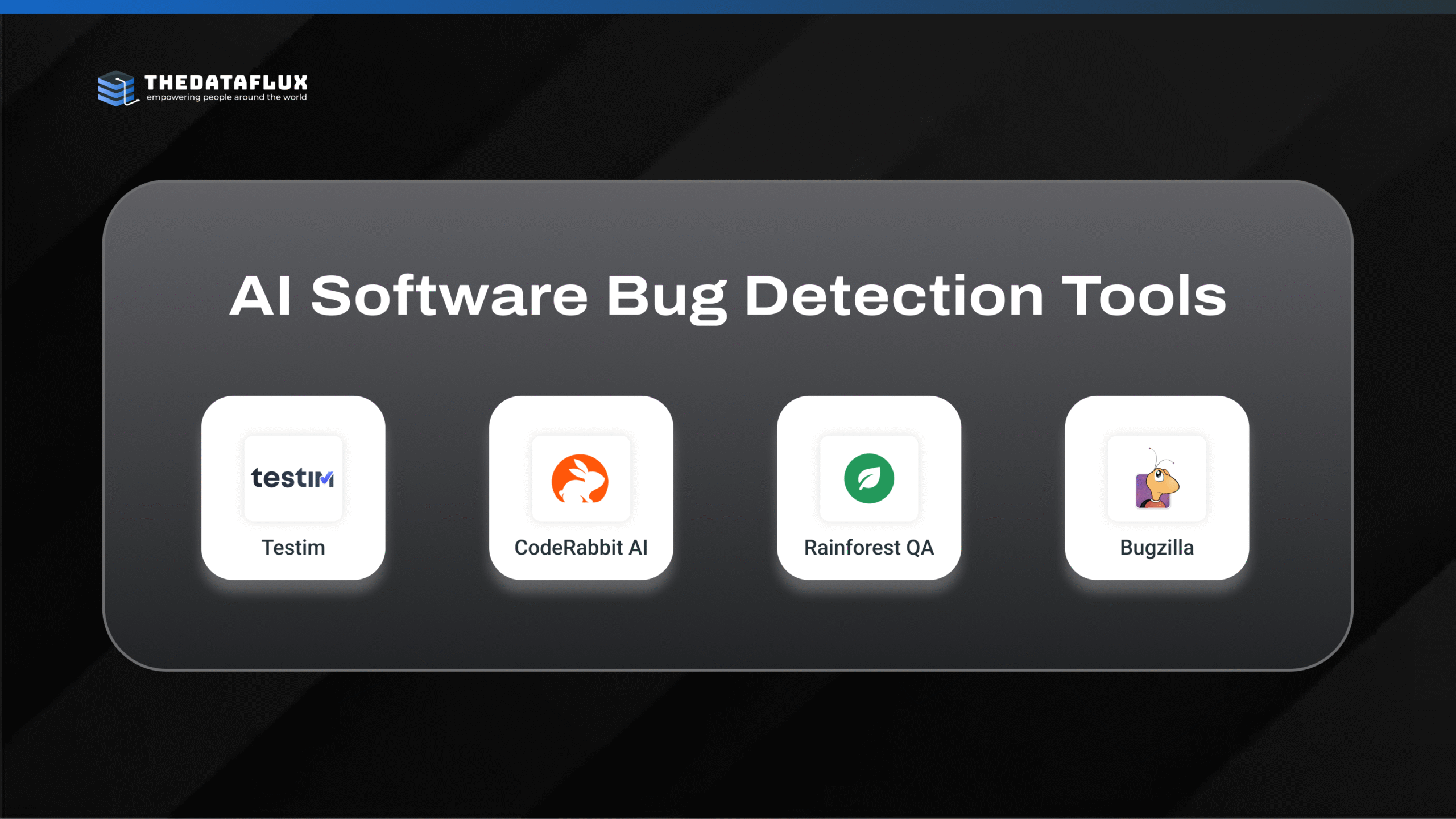
If you’re thinking about using AI to find bugs, the good news is some strong tools exist and they do a great job. Here are a few top players worth knowing:
• Testim
Testim uses AI to automate maintenance, execution, together with test creation. Code keeps tests stable even when it changes and adjusts to UI updates. It helps agile teams the most.
• CodeRabbit AI
AI feedback reviews pull requests, and CodeRabbit goes into your development workflow. It analyzes logic, structure, as well as test coverage gaps. This helps to catch issues in an early manner.
• Rainforest QA
Rainforest QA automates tests with no code. AI backs it. Wide test coverage with easy setup lets teams without big tech skills find bugs fast.
• Bugzilla
Even though Bugzilla is not AI-native, it is still in wide use, and it is often improved via machine learning plugins so it can track bugs. Big teams find it a sound pick because of its good problem-tracking features.
The Future of AI in Software Quality Assurance
AI is quickly changing what software testing will be because its power cannot be denied. Based on industry reports, the AI testing market all over the world had a value of $856.7 million back in 2024 and is expected to grow from $1,010.9 million in 2025 up to $3,824.0 million in 2032. This fast expansion results from the need for faster launches and better quality. Less work by hand adds up too.
Platforms for QA using AI are now being adopted within major enterprises and within even startups for speeding up releases and improving quality and for cutting costs. Really, predictions say that in 2026, over 80% of world companies will add AI with generative AI to how they work, and a key part will put it in testing tasks. This is more than a fad. The new standard for software quality assurance is now coming out fast.
AI can forecast as well as stop bugs in place of only finding them. AI looks at trends in code, testing scope, and past info. So we will find automation improved by application change. QA is going in that direction. It is quick, clever, and able to change.
Conclusion
We’re entering a new era of software quality assurance, where bugs are found faster, tests are smarter, and development cycles run smoother. And AI is at the center of it all.
At The Dataflux, we believe in building future-ready digital solutions. That’s why we integrate intelligent QA and AI-driven testing into everything we do, whether it’s automating test cases, improving bug detection, or streamlining entire release cycles.
If you’re ready to elevate your product quality and cut down the time and cost of testing, let’s work together. With the right tools and the right partner, you can transform your testing process, and The Dataflux is here to make it happen.
FAQs
Q- Why is AI important in software testing?
A- AI brings speed, accuracy, and intelligence to software testing. It helps identify bugs faster, reduce manual effort, and ensures better test coverage by learning from past data.
Q- Which AI feature helps in identifying defects more effectively in functional testing?
A- Machine learning is the key AI feature that improves defect detection in functional testing. It analyzes patterns, user flows, and previous test results to predict and pinpoint issues more accurately.
Q- How does AI improve bug detection?
A- AI continuously learns from historical bugs, code changes, and test results to spot defects faster and earlier in the development cycle. It automates repetitive checks and highlights high-risk areas before they break.
Q- Is AI automated bug detection better than manual testing?
A- AI-powered detection is faster, more consistent, and scalable compared to manual testing. While it doesn’t fully replace human testers, it significantly boosts efficiency and reduces missed bugs.