
Have you noticed how your mobile apps seem to know exactly what you want before you even ask? Netflix recommending the perfect show or a shopping app giving you a reminder about something you liked earlier, it’s not a coincidence. This is AI that is revolutionizing the way things work.
Just a few years ago, apps were only as smart as the buttons we clicked. Now, they learn, adapt, talk, and even understand what we need without spelling it out. And the most interesting part, users now expect apps to “think,” not just function.
From startups to global brands, AI has become the power behind better user experiences, faster development, and smarter decision-making. But how exactly is AI transforming mobile app development?
Let’s break it down in the simplest and most practical way.
What is AI in Mobile App Development?
Artificial Intelligence in mobile applications is not a story of advanced machines or a sci-fi world; it is about making an app more intelligent, interactive, and capable of deriving knowledge from user behavior.
When AI is integrated into an app, it enables features such as:
- Understanding voice or text commands
- Learning user preferences over time
- Predicting user actions or needs
- Offering personalized suggestions
- Automating routine tasks
In simple terms, AI works like the “intelligence layer” behind the app. Instead of waiting for every instruction, the app can analyze, respond, and even anticipate what the user may want.
AI is the biggest change to app functionality that we have seen in years. Just a few examples are: fraud detection in finance apps, voice assistants, recommendation engines, and chat-based support.
Benefits of AI-Powered Mobile Apps
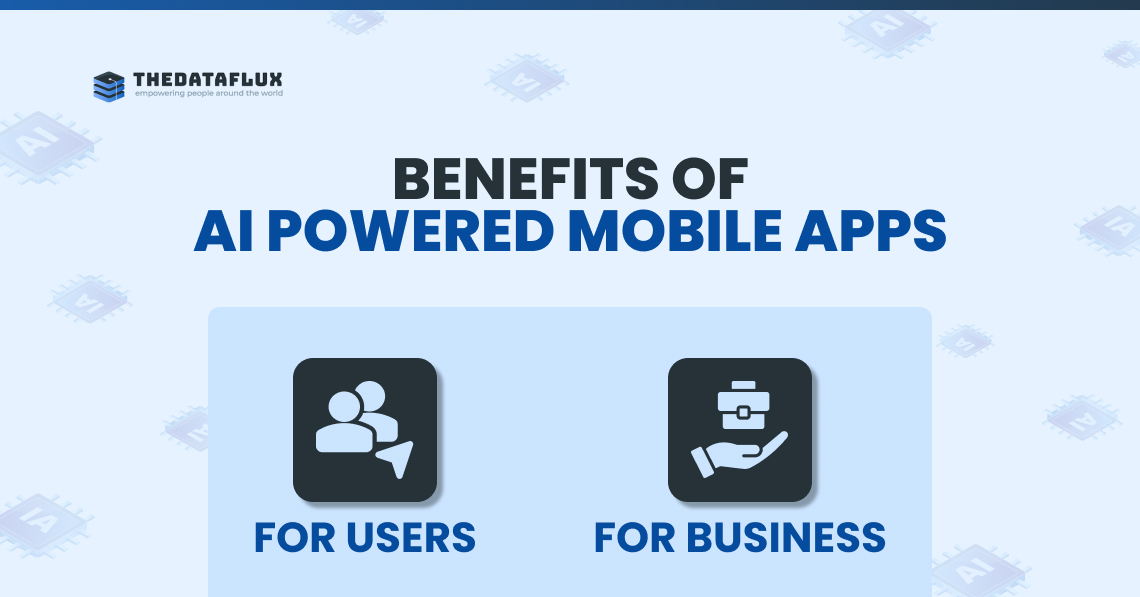
AI isn’t just a tech upgrade; it’s a practical advantage for both users and businesses. Let’s break down the benefits from both sides.
For Users
1. Personalized Experiences
Ever thought about how apps figure out what you want? AI analyzes user behavior and changes content, recommendations, and features to match the user’s likes and preferences in music, shopping, news, or fitness.
2. Improved Support
AI-powered chatbots and virtual assistants are always there to give you immediate support. They can respond to inquiries, resolve basic problems, and even guide users through tasks without any human intervention.
3. Smarter Interactions
With AI, apps become more user-friendly. The use of voice command, smart suggestion, as well as an adaptable user interface, provides the user with a natural and simple way of contact with the app.
4. Enhanced Convenience
From autofill and voice search to predictive text and smart navigation, AI reduces effort and makes everyday tasks faster and smoother.
5. Greater Security
AI helps identify unusual activity, prevent fraud, and enable authentication methods like facial recognition and fingerprint detection, making app usage safer and more reliable.
For Businesses
1. Increased Customer Engagement
AI keeps users coming back with relevant content, smart notifications, and personalized experiences that feel natural, not forced.
2. Data-Driven Insights
AI dives deep into the behavior of users and the trends they follow to provide insights that help businesses make the right decisions, enhance app features, and get the real user demands.
3. Operational Efficiency
Automation reduces manual work. AI handles tasks like support, data sorting, and user queries, saving time and resources.
4. Smart Marketing and Sales
By suggesting targeted and custom-tailored recommendations, a business can effectively use the techniques of upselling, cross-selling, and gently prompting users to take action at the right moment.
5. Competitive Advantage
In a crowded app market, AI sets businesses apart with smarter functions, better performance, and stronger customer loyalty.
How AI is Transforming Mobile App Development
With AI, not only are apps getting better, but the whole process of their design and the way they are experienced is changing. To a large extent, user commands have been dispensed with in modern AI-built apps that now can recognize the intent, adapt with the users’ preferences, and reply intelligently. As a result of this change, mobile apps have become less like instruments and more like smart companions.
One of the largest things AI has done for mobile app development is making the user experience more intuitive. Based on user behavior, apps are now able to change content, features, and navigation without receiving manual instructions. They are even able to predict a user’s next action and make suggestions accordingly.
For example, a shopping app could be recommending items to you even before you search for them, or a fitness app could be altering your plan in view of your activity – all these are AI operations continuing in the background to make the user interface more friendly.
AI Technologies Behind Smarter Mobile Apps
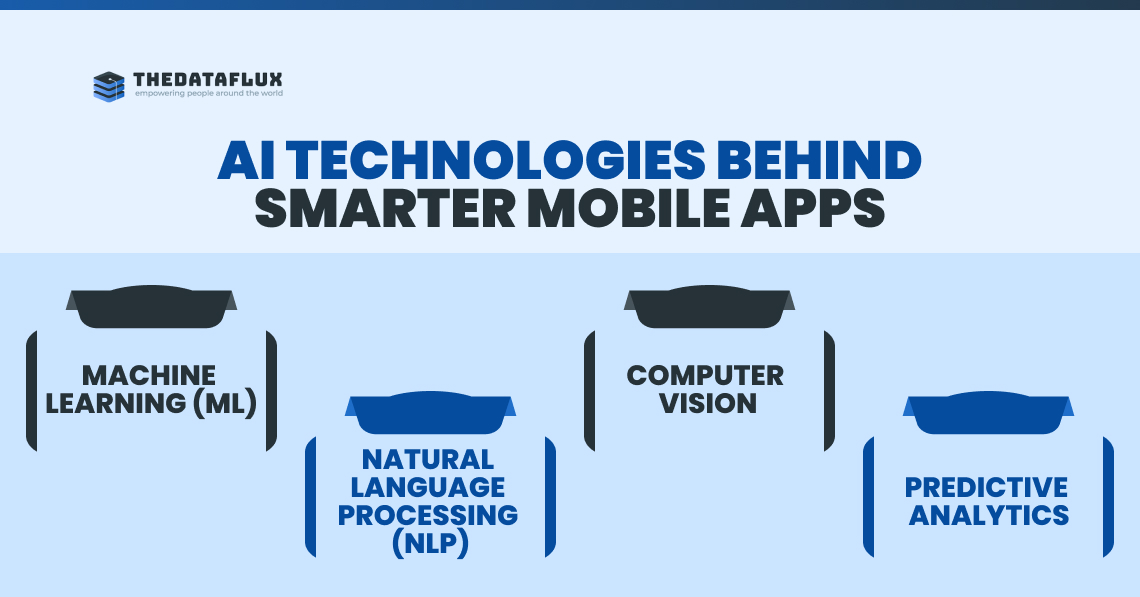
AI in mobile apps relies on several key technologies that make them smarter and more responsive:
Machine Learning (ML)
This allows apps to recognize patterns in user behavior and make predictions. From content recommendations to personalized experiences, ML helps apps adapt to users over time.
Natural Language Processing (NLP)
NLP enables apps to understand and respond to human language. This is what powers chatbots, virtual assistants, and voice commands, making interactions feel natural.
Computer Vision
This technology helps apps interpret images and videos. To be precise, computer vision is what makes it possible for an app to implement facial recognition, thus getting to “know” the user, as well as do general object recognition within the provided images/videos.
Predictive Analytics
By analyzing past data, predictive analytics helps apps anticipate user needs and actions. As a result, it is capable of providing not only more efficient notification features through smart alerts but also customer-friendly interaction modes and decision-making support for the business side that is enabled by the app.
AI’s Role in Creating More Intuitive Mobile Experiences
AI is making mobile apps feel smarter, smoother, and more intuitive than ever before. Now, apps no longer have to ask for clear instructions, as they can themselves figure out what users want and even adjust their strategies in real-time. This means that the behaviors drive the interfaces, personalizing is done by the system without much effort from the user, and the user can have a totally smooth interaction with the device.
For example, a fitness app is able to create workout plans that suit the user’s progress, an e-commerce app can give you a glance at the items that you are going to be buying, and an online financial app can recognize fraud even before a security breach is made.
By analyzing data continuously, AI allows apps to respond intelligently and provide value without overwhelming the user. Thus, the experience becomes simple, helpful, personalized, and ordinary apps get transformed into digital assistants that are actually proactive.
Final Thoughts
AI is changing the way we use and build mobile apps. Apps are no longer just tools; they’re becoming smarter, more intuitive, and tailored to each user’s needs.
For businesses, AI means better decisions, higher engagement, and more efficiency. For users, it’s about convenience, personalization, and smarter interactions.
At The Dataflux, we leverage AI to create mobile apps that are not only intelligent but also practical and user-friendly.
Hope you now have a clear understanding of how AI is transforming mobile apps. See you in the next blog!