
Introduction
Did you know that most software products don’t fail because of bad ideas, but because the technology behind them can’t keep up with change?
Software development technologies in 2026 are changing the entire software lifecycle, and those teams that refuse to adapt are already going to be left behind.
From AI that can write and test code to cloud platforms that scale in seconds, the way we build software is changing faster than ever.
In this blog, we’ll walk you through the top software development technologies for 2026, explain the real problems they solve, and show how they’re helping teams build better, faster, and more reliable software.
Top 10 Must-Have Software Development Technologies in 2026
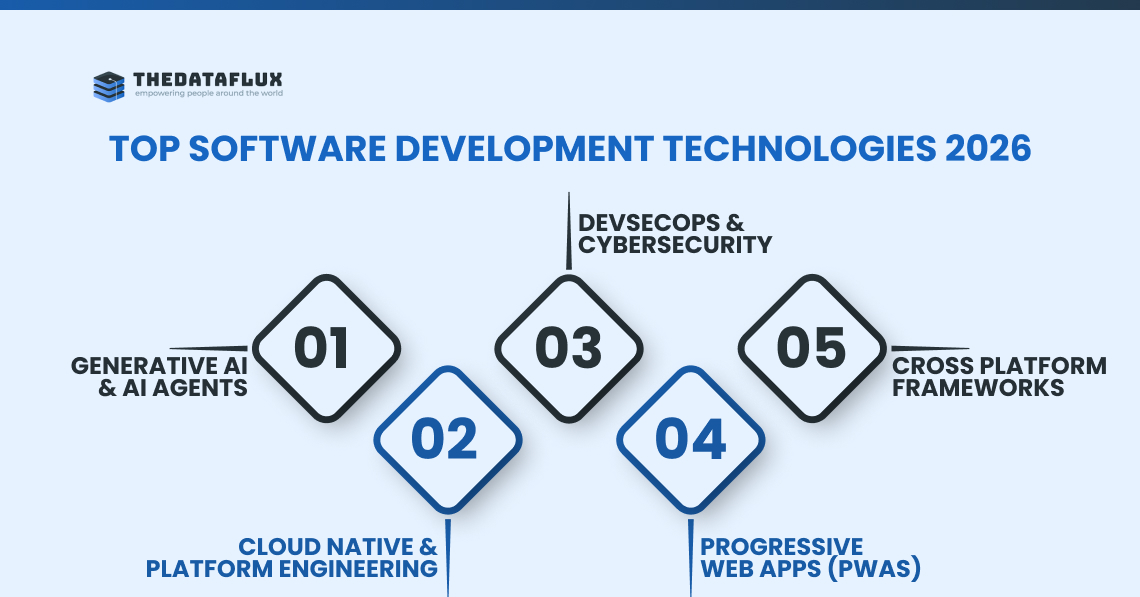
1. Generative AI & AI Agents
Problem:
Software teams spend too much time writing repetitive code, fixing bugs, and testing features manually. This slows down development and increases human errors.
Solution:
Generative AI and AI agents automate coding, testing, debugging, and even documentation. Developers get first-hand help from these intelligent systems, and the production time is shortened without a loss in quality.
Why It’s a Must-Have:
In 2026, speed matters more than ever. AI-powered development helps teams build faster, reduce costs, and focus on solving real business problems.
2. Cloud-Native & Platform Engineering
Problem:
Traditional infrastructure struggles to scale and leads to downtime during traffic spikes. Managing servers manually also increases operational complexity.
Solution:
Cloud-native platforms use containers, Kubernetes, and managed services to handle scaling automatically. Platform engineering simplifies infrastructure for development teams.
Why It’s a Must-Have:
Businesses need software that scales instantly and stays reliable. Cloud-native development ensures flexibility, resilience, and faster releases.
3. DevSecOps & Cybersecurity
Problem:
Security is often added late in development, making applications vulnerable to breaches. Fixing security issues after deployment is costly and risky.
Solution:
DevSecOps integrates security into every development stage. Automated security checks and continuous monitoring catch threats early.
Why It’s a Must-Have:
With rising cyberattacks, security can’t be optional. DevSecOps protects data, builds trust, and ensures compliance from day one.
4. Progressive Web Apps (PWAs)
Problem:
Users expect fast, app-like experiences, but native apps are expensive to build and maintain across platforms.
Solution:
PWAs combine the best of websites and mobile apps. They load quickly, work offline, and don’t require app store downloads.
Why It’s a Must-Have:
PWAs deliver better user experiences at lower cost. In 2026, they are essential for reaching users across devices.
5. Cross-Platform Frameworks
Problem:
Building separate apps for web, iOS, and Android increases development time and cost. Maintaining multiple codebases is inefficient.
Solution:
Cross-platform frameworks allow developers to write one codebase for multiple platforms. This reduces effort while maintaining performance.
Why It’s a Must-Have:
Businesses need faster launches and consistent experiences. Cross-platform development makes that possible without sacrificing quality.
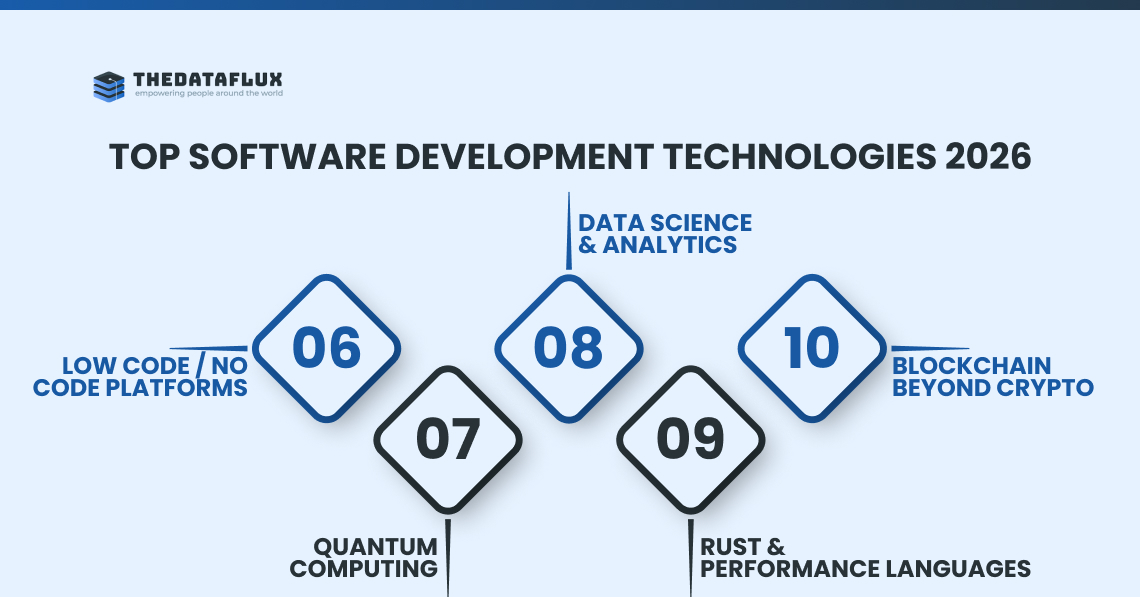
6. Low-Code / No-Code Platforms
Problem:
Development backlogs slow innovation, and non-technical teams depend heavily on developers for simple applications.
Solution:
Low-code and no-code platforms allow users to build apps using visual tools and minimal coding. Developers can focus on complex tasks.
Why It’s a Must-Have:
In 2026, speed and flexibility are key. These platforms empower teams and reduce development bottlenecks.
7. Quantum Computing
Problem:
Traditional computers struggle with complex calculations like large-scale simulations and advanced cryptography.
Solution:
Quantum computing processes massive data sets and complex problems much faster than classical systems.
Why It’s a Must-Have:
While still evolving, quantum computing is shaping the future. Early adoption gives businesses a competitive edge in advanced computing.
8. Data Science & Analytics
Problem:
Companies collect huge amounts of data but often fail to turn it into useful insights.
Solution:
Data science and analytics tools analyze patterns, predict trends, and support smarter decisions.
Why It’s a Must-Have:
In 2026, data-driven decisions define success. Analytics helps businesses understand users, reduce risks, and improve performance.
9. Rust & Performance Languages
Problem:
Many traditional languages face performance and security issues, especially in high-load systems.
Solution:
Languages like Rust offer memory safety, speed, and reliability without sacrificing performance.
Why It’s a Must-Have:
High-performance and secure applications are critical. Rust is becoming the go-to choice for modern, reliable software.
10. Blockchain Beyond Crypto
Problem:
Lack of transparency and trust affects industries like supply chain, finance, and healthcare.
Solution:
Blockchain provides secure, decentralized, and tamper-proof systems for data sharing and transactions.
Why It’s a Must-Have:
In 2026, blockchain is about trust, not just crypto. It enables secure systems across industries.
Why Are These Technologies Important in 2026?
Technology is no longer just supporting businesses. It is driving decisions, growth, and customer experience.
- Firstly, user expectations are extraordinary today. People demand quick, secure, and effortless digital experiences across various devices. Technologies such as AI, cloud-native platforms, PWAs, and cross-platform frameworks allow developers to fulfil user demands promptly.
- Secondly, speed and efficiency are the focus areas in businesses. Markets change quickly, and companies cannot afford long development cycles. Low-code platforms, DevSecOps, and AI-powered tools are shortening the product development cycles while keeping the products’ quality and security intact.
- Finally, data, security, and scalability are basics. With growing data volumes and cyber threats, businesses need technologies that protect systems, scale easily, and turn data into insights. This is where analytics, cybersecurity, blockchain, and performance-focused languages play a crucial role.
Top Software Development Tools
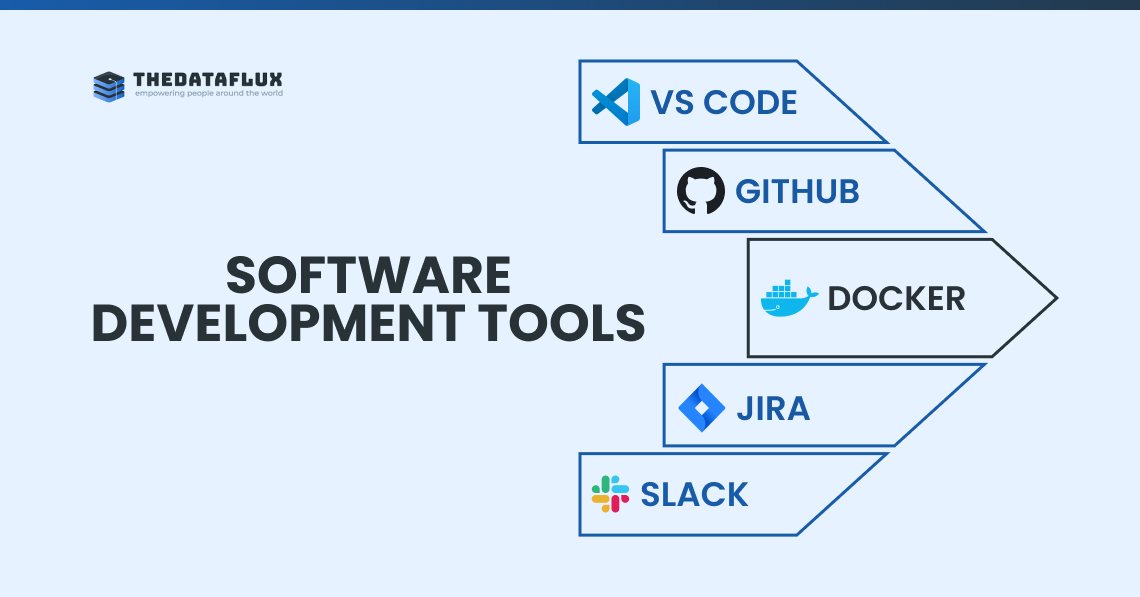
Technology works best when paired with the right tools. Here are some of the most important ones teams continue to depend on.
• Visual Studio Code (VS Code)
VS Code continues to be a top choice because it is lightweight, adaptable, and supports almost any programming language. With extensions and AI-powered features, it enables developers to work more quickly and intelligently.
• GitHub
GitHub is much more than just a version control system. It has become a platform for collaboration, automation, and AI-assisted programming, making team cooperation more convenient and effective.
• Docker
Docker is the tool that allows developers to create, test, and run applications the same way in different environments. That way, it minimizes the problems of “it works on my machine” and makes deployments faster.
• Jira
Jira helps teams in planning, tracking, and managing development work in a clear way. It makes sure that everyone is on the same page and that the projects move forward without any misunderstanding.
• Slack
Slack improves real-time communication between teams. It reduces email clutter and helps developers, managers, and stakeholders stay connected.
Final Thought
Software development in 2026 is all about working smarter, not harder. The right technologies and tools help teams build better products, solve real problems, and deliver value faster.
At The Dataflux, following these essential technologies is not only about trends. It’s about making software future-oriented that works for both people & businesses.
We’ll be back with more updates, insights, and practical tech discussions in the next blog.
Until then, keep your software evolving, stay open to new technologies, and make sure your systems are ready for what’s next.
FAQs
Q- What are the tech trends in 2026?
A- 2026, tech trends focus on AI-driven development, cloud-native platforms, DevSecOps, low-code tools, and stronger cybersecurity. These technologies help businesses build faster, scale easily, and stay secure in a digital-first world.
Q- Which technology is best for software development?
A- There is no single “best” technology; it depends on the project’s needs. However, AI-powered tools, cloud-native architectures, and modern frameworks like cross-platform and low-code solutions are among the most widely used in software development today.
Q- What are the 13 types of software developers?
A- Common types include:
- Front-end, 2. Back-end, 3. Full-stack, 4. Mobile App, 5. DevOps, 6. Cloud, 7. AI/ML, 8. Data, 9. Security, 10. Game, 11. Embedded systems, 12. Blockchain, and 13. QA developers. Each role focuses on a specific part of building, running, or improving software systems.
Q- What are the 10 latest technology trends?
A- The latest trends include generative AI, cloud-native development, DevSecOps, progressive web apps, cross-platform frameworks, low-code platforms, quantum computing, data analytics, performance-focused languages, and blockchain beyond crypto.
Q- Which technology is used in software development?
A- Software development uses a mix of programming languages, frameworks, cloud platforms, databases, and development tools. Technologies like GitHub, Docker, cloud services, and modern IDEs are commonly used to build and manage applications.
Q- What is software development technology?
A- Software development technology refers to the tools, frameworks, languages, and platforms used to create software applications. These technologies help developers design, build, test, deploy, and maintain reliable and scalable software.