
People are spending 88% of their mobile time on apps, not browsers. And with more than 6.8 million apps available worldwide, users expect these apps to be fast, intelligent, and personalized from the very first tap.
That’s exactly where AI comes in helpful.
Whenever you get a perfect movie recommendation, a chatbot sends you a smart reply, or the system informs you of the best route before you even start searching for it, AI is already working behind the scenes. Today, AI is not only an option in mobile apps; it is the technology that is transforming how the apps think, behave, and respond like real humans.
In this blog, we’ll walk through what AI in mobile app development really means and how it’s transforming the industry.
What is AI in Mobile App Development?
AI in mobile app development means building apps that can think, learn, and make decisions the way humans do, without being manually programmed for every single action.
Instead of apps following fixed instructions, AI-powered apps analyze data, understand patterns, and adapt to each user. That’s why your app experience feels different from someone else’s, even though you’re using the same app.
Think about:
- Netflix recommends shows based on what you watch
- Google Maps is suggesting faster routes based on traffic
- Shopping apps recommending products you didn’t even know you needed
All of this happens because AI helps apps understand behavior, predict needs, and give users a smoother, smarter experience.
How AI is Changing Mobile App Development
AI is reshaping mobile apps from the inside out, not just in how they look, but in how they think. With the help of AI, these apps do not have to wait for their users to take an action; they are allowed to take the initiative themselves. Hence, apps have the ability now to forecast what their users require, reply swiftly, and develop experiences that are friendly rather than impersonal.
Developers are also benefiting in a big way. The use of AI tools takes less time in writing the code, testing, finding and fixing bugs, and even in making decisions with regard to the design. What was formerly a matter of weeks has now become a question of days due to the fact that AI is always ready to provide relief from the monotonous work and enhance the precision.
For companies, there is a massive impact. The rise of intelligent applications means that users get a better experience, thus resulting in the growth of user engagement and an increase in the number of conversions.
In a world where there are millions of apps that are competing for the attention of users, AI is the secret weapon that can help firms to be noticed, to be able to keep up with the latest trends, and to be in a position to offer the kind of experiences that are helpful and truly solve the users’ problems.
AI Technologies Behind Smart Mobile Apps
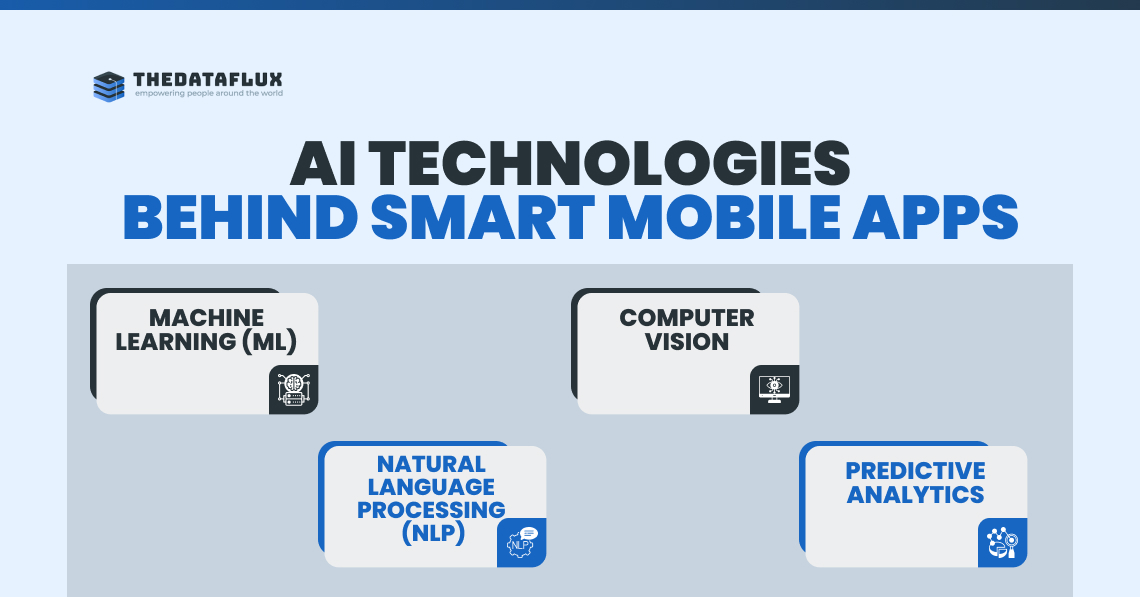
Machine Learning (ML)
With the help of ML, apps understand user behavior by observing what a user clicks, ignores, or searches for and subsequently use this information to customize the user’s experience. This technology is the main reason why applications can recommend products, make predictions about what you want next, or give you a warning before something goes wrong.
Natural Language Processing (NLP)
NLP gives the power to apps to understand and react to human language. This is the main source of chatbots, voice assistants, and even simple voice-to-text functionalities. With this, the app-user interaction becomes more real, fluent, and of the human communication style.
Computer Vision
With Computer Vision, apps could “see” and understand the content of an image or a video. Technologies like face recognition, barcode scanning, AR filters, and document scanning are possible because of the visual interpretation of what is captured by the camera, done by apps.
Predictive Analytics
By using Predictive Analytics, apps can keep the upper hand by evaluating previous trends and estimating what users might require next. It can do a lot of things, such as forecasting traffic, recommending content, or reminding users about their upcoming tasks, giving the app a new level of smartness.
Real-World AI In Mobile Application Success Stories
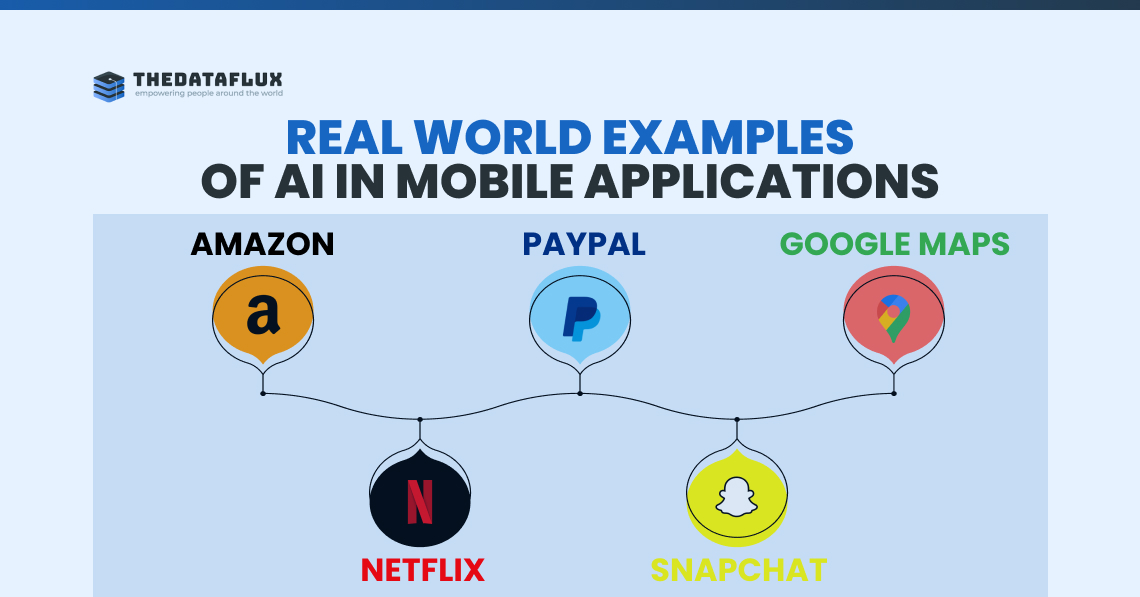
Here’s how some of the world’s biggest brands are using AI to deliver smarter, faster, and more personalized mobile experiences.
Amazon
Amazon uses AI to study your browsing patterns, purchase history, and even the time you spend looking at certain products. That’s why the app feels like it “knows” what you want, because it does. AI helps Amazon show better product recommendations, faster search results, and smarter delivery predictions.
PayPal
PayPal processes millions of transactions every day, and AI helps keep users safe. Its AI models scan every transaction in real time to spot unusual patterns, like strange locations or rapid purchases. This allows PayPal to flag suspicious activity instantly and protect users from fraud without slowing them down.
Google Maps
Google Maps uses AI to analyze real-time traffic data, historical patterns, and user movements. That’s how it predicts traffic jams, gives alternate routes, and estimates arrival times with surprising accuracy. From suggesting the best time to leave to rerouting you mid-trip, AI does the heavy lifting behind the scenes.
Netflix
Netflix uses AI to track what you watch, how long you watch, what you rewind, and even what you skip. This helps it recommend movies and shows you’re more likely to enjoy. AI also powers Netflix’s content previews, search results, and streaming quality optimization.
Snapchat
Snapchat’s fun filters and AR effects exist because of AI, especially Computer Vision. AI maps your facial expressions in real time to add lenses, animations, and effects that move with you. Everything from beauty filters to AR-based games depends on this layer of AI intelligence.
Choose The Dataflux for Your AI App Development Needs
- We turn AI ideas into real, smart apps.
At The Dataflux, we don’t simply produce apps that are trendy but use AI technologies such as ML, NLP, Computer Vision, and predictive analytics to enhance every interaction, thus making the apps smarter and more meaningful.
- We focus on real-world results, not just features.
By using our designs, you will get the right solutions that create an excellent user experience and raise the business through personalized user journeys, automation, AI-powered chatbots, or smarter decision-making.
- We make the development process simple and transparent.
You stay in control of the vision while we handle the complex technical side, giving you clear updates, flexible collaboration, and a smooth development journey from idea to launch.
- We help you stay ahead in a competitive market.
AI is going to be the essence of the next generation of apps, and with The Dataflux as your partner, your product is the one that will stay relevant, fast, and ready for the future.
Final Thoughts
AI is not simply a “nice-to-have” feature as it used to be; it is actually turning out to be the core of every successful mobile app. Smarter search, personalized recommendations, real-time decisions, or seamless interactions are some of the ways through which AI is quietly revolutionizing the apps we use every day.
If you are only thinking about building an app or upgrading the one you already have, then this is the moment to shift to AI-powered experiences. And if you want a team that is tech-savvy and also understands the business side, The Dataflux is the right place to be to get something that users will really love.
See you in the next blog — until then, think of what your next app might become with the right AI assisting it.
FAQs
Q- Can I use AI to build a mobile app?
A- Yes, you can absolutely use AI to build a mobile app. AI helps apps become smarter by learning user behavior, automating tasks, and improving overall experience. Many modern apps use AI for personalization, recommendations, chatbots, and predictions.
Q- What is the role of AI in mobile app development?
A- AI enhances mobile apps by making them more intuitive and user-friendly. It helps apps understand users better, respond faster, and offer smarter features like voice commands, real-time suggestions, and automated decisions. Overall, AI improves engagement and efficiency.
Q- How do I add AI to my mobile app?
A- You can add AI to your app by integrating tools like machine learning models, NLP engines, or computer vision APIs. Developers usually use services such as TensorFlow Lite, Google ML Kit, or third-party AI APIs to build smart features. The right approach depends on your app’s goals and user needs.
Q- How is AI used in application development?
A- AI is used to automate tasks, analyze data, personalize user experiences, and improve decision-making inside apps. It can power chatbots, security features, recommendations, predictions, and even coding assistants. In short, AI helps apps work smarter, not harder.
Q- Which AI is best for mobile app development?
A- There’s no single “best” AI; it depends on the app’s purpose. Tools like Google ML Kit, TensorFlow Lite, IBM Watson, and OpenAI APIs are popular choices for different AI features. Developers pick the one that fits their feature needs, speed, and platform compatibility.
Q- What is the role of AI in applications?
A- AI helps applications learn from data, adapt to users, and make intelligent decisions automatically. It improves efficiency, accuracy, and overall user satisfaction by powering features like personalization, automation, search optimization, and voice recognition. Essentially, AI turns simple apps into smart apps.